About nine months ago, I wrote about starting a garden. I am not a gardening expert, I just needed something to do with my hands in what felt like a strange in-between season.
As I mentioned in my previous gardening post, my daughter had just left for college. My husband was busy with work. My son was deep in school. And after a long year marked by surgeries, transitions, and loss, I suddenly had space, emotionally, physically, spiritually, that I hadn’t had in a long time.
I didn’t want to rush to fill it, as is my tendency. I actually enjoy a full schedule, and my curiosity often drives me to say yes to whatever crosses my path. But this time, I wanted to be more intentional. In my attempt to slow down and create room for something different, a garden felt like a quiet, safe thing to say yes to.
In a lesson I heard recently, someone pointed out how often Jesus tells us to “look”. Look at the birds of the air. Look at the lilies of the field. Look at the harvest, the seeds, the soil. He didn’t just teach with words, He taught with what already surrounds His listeners, inviting them to stop and see.
Here are a few things I’ve learned when I’ve taken the time to look, to pay attention to what is growing, or at least what might be trying to break ground.
1. Look at the Tiller: You Have to Break the Ground if You Want Deep Roots
I wasn’t going to till. I thought I could get by with a little raking of the topsoil. But I quickly learned: if the ground underneath stays hard and compacted, the roots won’t go deep. They’ll hit resistance and stop.
So I rented a tiller (I still have compassion on the Home Depot guy. Such patience!).
At first, I just walked behind it at a normal pace. I genuinely marveled at how easy tilling was. Until I realized nothing was happening. The tiller was just skimming across the surface. I realized I had to slow down, hold it in place, and give it time to dig in. I also learned quickly that if I stayed too long in one spot, it would get stuck, spinning, digging, and going nowhere.
That felt uncomfortably familiar.
Sometimes I rush through spiritual growth, skimming over the surface of things. Other times (more often than not), I get stuck overthinking, paralyzed in the same spot. But real transformation takes both pause and progress.
“Break up your fallow ground, for it is time to seek the Lord” (Hosea 10:12).
God isn’t afraid to dig deep. He invites me to stay still long enough to let Him, and then invites me to move forward in trust.
2. Look at the Seeds: You Can’t Plant Everything (Even If the Seed Packet Is Beautiful)
Choosing seeds was harder than I expected. Everything looked like a good idea, bursting with promise, color, and potential. I wanted to plant it all. I had visions of frolicking through my neighborhood, tossing armloads of homegrown veggies to my new neighbors. But my space was limited, and every seed needed something different to thrive: full sun or partial shade, constant water or dry soil, deep ground or shallow roots.
That alone taught me something. I can’t grow everything. And neither can my heart.
But the lesson didn’t stop there. Each seed’s unique needs reminded me that people are like this also. Not everyone in my life needs the same kind of encouragement, presence, or care. Some friends need frequent connection. Others need space to thrive (I definitely relate to this!). Some feel loved by words; others, by quiet consistency.
When I try to treat everyone the same or assume what I need is what they need, I miss the opportunity to love them well.
“Let each of you look not only to his own interests, but also to the interests of others” (Philippians 2:4).
Love asks us to pay attention. To get to know each other’s soil. It might look like asking your spouse or friend, “What makes you feel most supported right now?” It might mean recognizing that your teenager may not need the same kind of encouragement that speaks to you, and that’s okay. It might look like letting go of the guilt of not being everything to everyone, and instead choosing to love a few people well, with intention and care. And while I’m tempted to feel guilty at times not showing up in all the ways I want to, I’m realizing that making these choices isn’t selfish, it’s stewardship.
3. Look at the Shovel: Weakness Is Not the Enemy of Growth
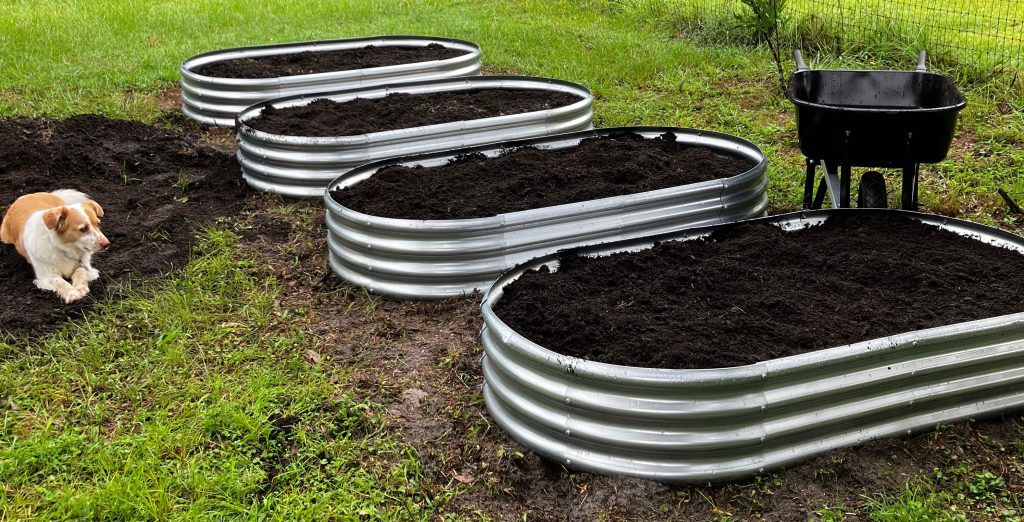
Filling the garden beds with dirt was physically hard work. I had two tons of topsoil and manure delivered, and every single shovelful had to be moved by hand into each raised bed. My muscles ached. My hands blistered. My back protested. But alongside the soreness, I felt gratitude because I could do it. I was strong enough to handle the work in front of me. Not every day is like that, and I know that for some people, this task wouldn’t even be possible.
Personally, I’ve always seemed to get sick more often than others. While I’ve usually been able to show up for what’s essential, my health has been a consistent thorn in my side. Once, on a mission trip, I was publicly honored as “the sick one.” That label stayed with me longer than I’d like to admit.
I know I’m healthier than many, and I don’t want to take that for granted. But I’ve also carried a quiet, simmering shame about this weaker part of me. I often feel like I should be stronger, more consistent, less needy.
But I’m learning to see it differently. Maybe my limitations aren’t a flaw to fix, but a part of how God formed me. And maybe honoring those limits is actually an act of worship, not weakness.
“My grace is sufficient for you, for my power is made perfect in weakness.” (2 Corinthians 12:9)
If God knit me together, then He knows what I need, even when what I need is more rest, more sleep, or a slower pace.
Now, raising a daughter with chronic illness, I want her to know this too: her value isn’t tied to productivity. Her need for care isn’t something to hide. She isn’t “less than.” She is made differently, intentionally, and beautifully, able to do all God has planned for her.
4. Look at the Overgrowth: Growth Needs Space to Thrive
I made a mistake: I didn’t thin the plants. I just couldn’t bring myself to do it. They were all growing, so fragile and full of potential. Like little green babies. How could I choose which ones to pull? I genuinely felt sadness about letting anything go, pulling anything up.
But over time, I saw the results. Disease spread. Roots tangled. Nothing thrived.
I had created an overcrowded space, hoping everything could stay, and everything would flourish. Instead, the health of the entire garden was impacted.
I’ve done that in life, too. I’ve held on to too many roles, relationships, and responsibilities, afraid to let go, not wanting to hurt anyone or cause disappointment. I am afraid of making the wrong decision, or even of saying no to the wrong thing, the thing that God possibly placed there. But sometimes what’s needed most is trust: trust that pruning leads to fruit. Trust that God in His grace will work with my clumsy efforts at pruning as I seek to create space to grow closer to Him.
“Every branch that does bear fruit He prunes, that it may bear more fruit” (John 15:2).
Pruning isn’t rejection or cruel. It’s living with intentions. It’s providing the space for God to grow something better, something fuller, something stronger.
5. Look at the Trellis: Growth Needs Support or It will Rot
If you visit my garden, you will see a tangle of wooden and plastic stakes, tied together with twine. This is my awkward, slightly late attempt at provisioning a trellis for my rapidly growing, slightly overcrowded (remember my lack of thinning!), plants.
Ken Shigematsu writes in God in My Everything, “A trellis is a support system for a vine or plant that enables it to grow upward and bear fruit. Without it, the fruit tends to rot before it ripens.”
I believe that’s true of our lives, too. Without structure, without spiritual rhythms or a rule of life, we may grow, but we grow in all directions, weighed down by our own burdens, unable to reach the light. The trellis doesn’t control the plant. It simply supports and guides it so it can receive the nourishment necessary for growth and fruit. The trellis isn’t the vine, it provides space for the vine to grow.
Our trellises might look like time in Scripture, moments of prayer, weekly Sabbath, quiet walks, or trusted friendships. As Shigematsu shares, they’re not meant to be rigid rules. They’re flexible scaffolding, helping us grow toward the Son, the source of our growth and fruitfulness.
“Remain in me, as I also remain in you. No branch can bear fruit by itself” (John 15:4).
6. Look at the Fruit: Don’t Forget to Enjoy the Garden
I wrestle a bit with anxiety. If there is something to be anxious over, I can usually find it. The same seems to be true even of my peaceful garden. There was a moment, several actually, when I realized I had spent more time researching pests, inspecting leaves, and watching for blight than I had just enjoying the miracle of things growing.
I was so focused on what could go wrong that I nearly missed what was already going right.
It’s easy to do this in our spiritual lives, too. We can stay in a permanent state of self-examination, pulling weeds, watching for intruders, correcting every flaw, and miss the beauty of what God is actually doing, the ways He is actually working in us and through us.
“They will be called oaks of righteousness, a planting of the Lord for the display of His splendor” (Isaiah 61:3).
We were made to grow and delight. There is a time to examine the soil, AND a time to sit in the sun and marvel at the fruit.
Still Growing…
I still struggle with feeling like I’m only as valuable as what I produce. I still catch myself measuring days in output and efficiency (I look forward to the day when I sincerely write something different!). I want to learn a different rhythm, the kind rooted in grace, not performance. There’s something freeing about learning to trust how God sees us: enjoyed even in the slow, quiet work of becoming.
“Do not despise these small beginnings, for the Lord rejoices to see the work begin” (Zechariah 4:10, NLT).
Ultimately, growth is never something we can manufacture. We can till and prune, plan and weed, but when a seed finally breaks open, it’s always a miracle. Something sacred. Something only God can do. Our lives are the same way. We get to participate in the process, but we are not the source. “So neither the one who plants nor the one who waters is anything, but only God, who makes things grow” (1 Corinthians 3:7, NIV).
We have the privilege of showing up, of preparing the soil, noticing what’s happening, and practicing the discipline of “looking.” But even that is all grace. Because at the end of the day, it is God who brings life from the dirt. God who tends to us with patience. God who sees what’s hidden, waters what’s dry, and never gives up on what He’s planted.
How can we not love Him for that?
 Thin Air, High Hope
Leave a comment